
Reading Your Picture Book Aloud: The Rhythm Test, and When Rhyme Works
One of the first things we do with a promising picture book manuscript at EK Books is read it aloud. Out loud, and often more than once. That isn’t a quirk of our office. It’s simply how picture books are meant to be experienced, and it’s the quickest way to find out whether a text is truly ready.
If you do only one thing before you submit, do this: read your story out loud, properly, and listen to what it tells you. Here’s how to run what we call the rhythm test, what the results usually mean, and how to decide whether rhyme is helping or hurting your book.
Why picture books live or die out loud
A picture book has two audiences at once. There’s the child, who usually can’t read the words yet and is listening, looking and turning pages. And there’s the adult doing the reading, whether that’s a parent at bedtime, a grandparent on the couch or a teacher in front of thirty wriggling five-year-olds.
That adult may read your book dozens of times. A sentence that trips the tongue on the first reading becomes a chore by the tenth and a reason to hide the book by the fortieth. A text that is a pleasure to say gets requested again and again. Booksellers, librarians and teachers know this, which is why publishers listen so closely to how a story sounds.
How to run the rhythm test
Murmuring your words at your desk isn’t the same as performing them. Try these steps in order.
- Print it and stand up. Read from paper, at the pace you would use with a child on your lap, and in a full voice. Reading on screen makes it far too easy to fix things silently as you go.
- Mark every stumble. Keep a pencil in hand. Wherever you pause unexpectedly, hesitate, run out of breath, or find yourself going back to say a line again with a different emphasis, put a mark in the margin. Each mark is a spot that needs more work.
- Hand it to someone else, cold. Ask a friend who has never seen the manuscript to read it to you while you stay silent. Where they stress a different word from the one you intended, the rhythm is living in your head rather than on the page. An editor will read it the way your friend did.
- Read it with the page turns. Break your text into spreads as it would appear across a 32-page book and pause at each turn. (If you haven’t done this yet, our guide to mastering the 32-page format walks you through it.) Does each turn land on a moment of suspense, a surprise or a laugh? Or does a sentence get chopped awkwardly in half?
- Read it to children. If you can, read to children in the right age range. Watch rather than ask: where do they lean in, fidget, or start joining in uninvited? Those reactions are more honest than any feedback form.
What your pencil marks usually mean
After hundreds of read-throughs, we see the same culprits behind most stumbles:
- Sentences too long for one breath. If you need to gulp air mid-line, a child will lose the thread too.
- Accidental tongue-twisters. Clusters of similar consonants that look fine on paper but tangle in the mouth.
- Stress falling in the wrong place. The natural emphasis of the sentence fights the beat you want.
- Back-to-front word order. Phrases like “home she ran” or “so tired was he” that nobody would ever say in conversation.
- Padding. Little filler words such as “very”, “just” or “did go” added to make a line the right length.
- Description the illustrator will handle. If a line describes what a character is wearing or what the room looks like, it often reads flatly aloud because the pictures should be doing that job.
Rhythm matters in prose, too
Many authors assume the rhythm test only applies to rhyming manuscripts. In fact, most of the picture books we publish are written in prose, and the best of them have just as much music. Prose rhythm comes from a few reliable tools:
- Varying sentence length. A short sentence after a long one lands with real force.
- Repetition with a twist. A pattern that repeats, then changes at the key moment, gives children the joy of predicting and the delight of surprise.
- A refrain. A line that returns throughout the story invites children to join in, which is exactly what you want at storytime.
- Sound words. Onomatopoeia and playful verbs are fun to say and easy to perform.
Here’s a quick example. “Bea looked under the bed. She looked behind the couch. She even looked inside the fridge, which was silly, and she knew it.” There’s no rhyme there at all, but the pattern builds, the third line breaks it, and the little joke at the end gives the reader something to play with.
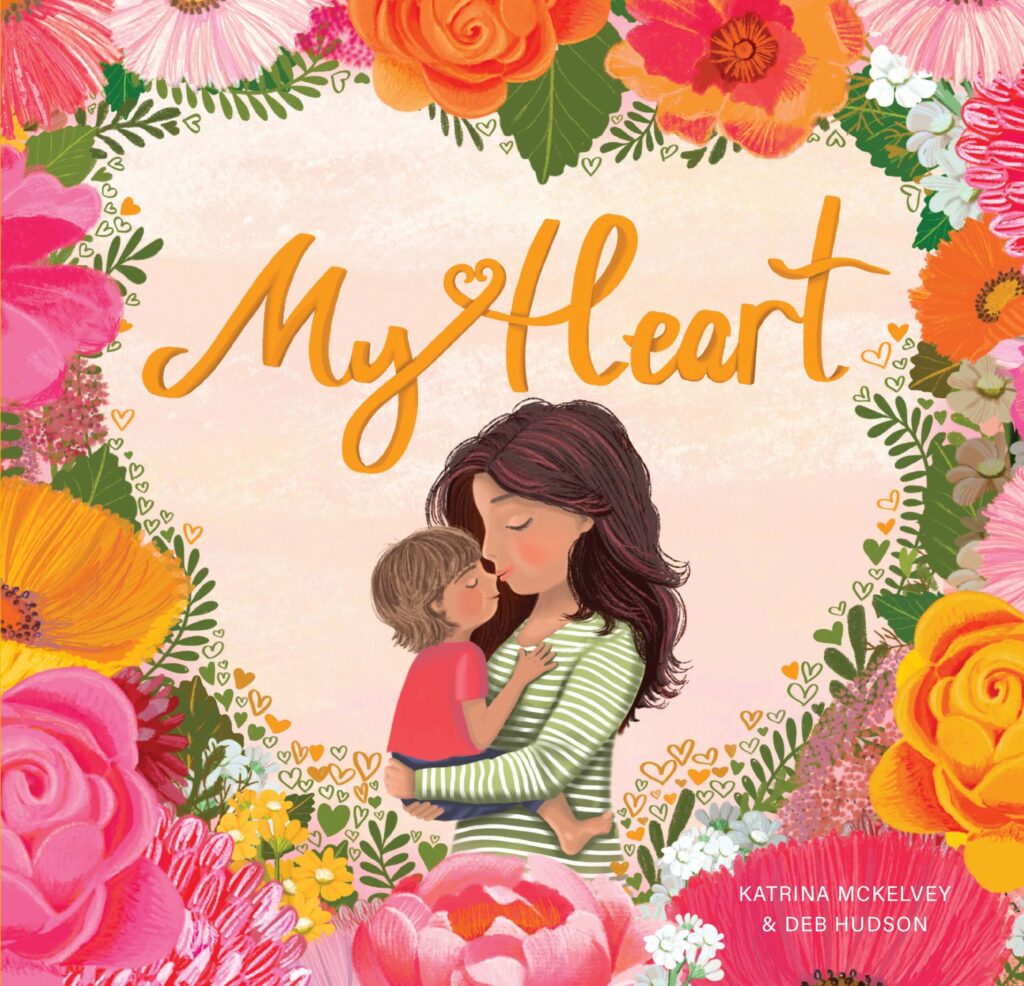
The book on the cover of this post, My Heart by Katrina McKelvey and Deb Hudson, is a lovely illustration of the idea: it uses subtle repetition, working hand in hand with the pictures, to carry the emotional thread from page to page.
When rhyme works
We’re not against rhyme. Children love it, and a brilliantly rhymed picture book is a joy to read. But rhyme is one of the hardest things to do well in children’s writing, and we’ve written before about why rhyme may not be the best choice for your children’s book. If you’re determined to write in verse, these are the tests your manuscript needs to pass.
- The metre is consistent. Clap or tap the beats of each line. Lines that should match need the same number of beats, with the stresses falling where the words naturally fall.
- Every line sounds like real speech. If a word is there only because it rhymes, a publisher will hear it straight away.
- The rhymes work in more than one accent. EK Books sells into Australia, New Zealand, the UK and North America. A rhyme that depends on how one region pronounces a vowel may fall apart elsewhere.
- The story would still stand up in prose. Rewrite two or three spreads without the rhyme. If there’s still a character who wants something, a problem and a satisfying resolution, the rhyme is a bonus. If the story evaporates, the rhyme was doing all the work.
- The tone suits the subject. Bouncy verse can feel jarring when a book deals with grief, worry or big feelings. Gentle, measured verse can work, but it takes an extremely sure hand.
Rhyme should feel effortless to the reader. Behind that ease is usually a great deal of effort from the author.
If your verse passes all five tests and survives a cold read without a stumble, wonderful. If not, try retelling the story in rhythmic prose. Many authors find it gets stronger once it’s free to go wherever it needs to.
What a smooth read-aloud tells a publisher
When a manuscript reads beautifully aloud on the first try, it tells us you’ve thought about your real audience, revised carefully and understand how picture books work in homes and classrooms. It’s one of the clearest signals that a manuscript is ready for submission.
Key takeaways
- Picture books are performed, so publishers read manuscripts aloud. You should too.
- Mark every pause, hesitation or re-read. Each one is a line to revise.
- Have someone else read your story cold. Where they stumble, an editor will too.
- Prose needs rhythm as much as verse does. Use sentence length, repetition and refrains.
- Only rhyme if the metre is consistent, the language is natural and the story would still work in prose.
Get ready for when EK Books submissions reopen
Making a manuscript sing on the page and out loud is exactly the sort of craft we teach at Children’s Publishing Academy, drawing on what we do every day as working publishers at EK Books. Our Children’s Author Certification takes you from first idea to a submission-ready manuscript, so you’re ready for when EK Books submissions reopen.
Wondering how your story measures up right now? Take our free Is Your Children’s Book Ready for Publication? quiz and find out in a few minutes.