
Why Your Picture Book Shouldn’t Be “Book 1 of a Series”
It’s one of the most common lines we see in a cover letter: “This is the first book in a planned series of six.” Sometimes the author has already sketched out the sequels, named the supporting characters and imagined the boxed set. The enthusiasm is lovely. But to a picture book publisher, that sentence usually works against a manuscript rather than for it.
Here’s why, and what to do with all those wonderful ideas instead.
Picture books are bought one at a time
Picture books are almost always standalone titles. Parents, grandparents, teachers and librarians pick up a single book because the story, the art and the feeling of it speak to them right there in the bookshop or the library. Most of them will never know, or mind, whether a sequel exists.
Series thinking belongs mostly to older readers. Once children move into junior fiction and chapter books, they start following characters from book to book, and publishers plan for that from the outset. In picture books, series are the exception. They tend to happen in one of two ways: a published book becomes a hit and readers ask for more, or the series grows out of a character already well known from television or another medium.
In other words, a picture book series is usually earned, not pitched.
What publishers hear when you pitch a series
When an editor reads “Book 1 of a series”, a few concerns surface straight away.
- The commitment is bigger. Deciding on one picture book means weighing up an illustrator, a production slot, printing and marketing for that one title. Proposing six asks a publisher to commit to a much larger investment before anyone knows whether readers will love the first.
- The story may not stand on its own. Manuscripts written as the opening instalment of something bigger often feel like a set-up. The characters are introduced, the world is built, and then the story stops just as it gets going.
- The author may be less open to change. If a whole series hangs on a particular premise, character or setting, an editor may worry that suggested edits will be resisted because they’d unravel books two to six.
None of these is fatal on its own, but together they make a manuscript harder to say yes to. And with a stack of submissions to read, a harder yes often becomes a no.
The “introduction” trap
The biggest problem is usually on the page, not in the cover letter. When writers think of their story as the first in a series, they often write it like a pilot episode. Page after page goes into establishing who everyone is, where they live and what they like. The real story, the problem that needs solving, arrives late or not at all, because it’s being saved for later books.
A picture book has 32 pages, and once you allow for the title and imprint pages you have roughly a dozen spreads to tell a complete story. There’s no room for a prologue. Every spread needs to move the story forward. If you’d like to see how that space breaks down, our guide to mastering the 32-page format walks you through it.
What a standalone story needs
A picture book should give a young reader a full, satisfying experience in one sitting. That comes down to three things.
A clear problem
Something needs to be at stake within the first spread or two. It doesn’t have to be dramatic, but it has to matter to your main character, and the child listening should feel that it matters too.
A character who acts
Your main character should drive the story: trying things, getting it wrong and finding a way through. Children love seeing someone their own size solve their own problem.
A resolution that actually resolves
Young children like endings that are clear. The problem raised at the start should be settled by the end, in a way a four- or five-year-old would find satisfying. Open endings, cliffhangers and “to be continued” can work for older readers, but in a picture book they tend to leave both the child and the adult reading aloud feeling short-changed.
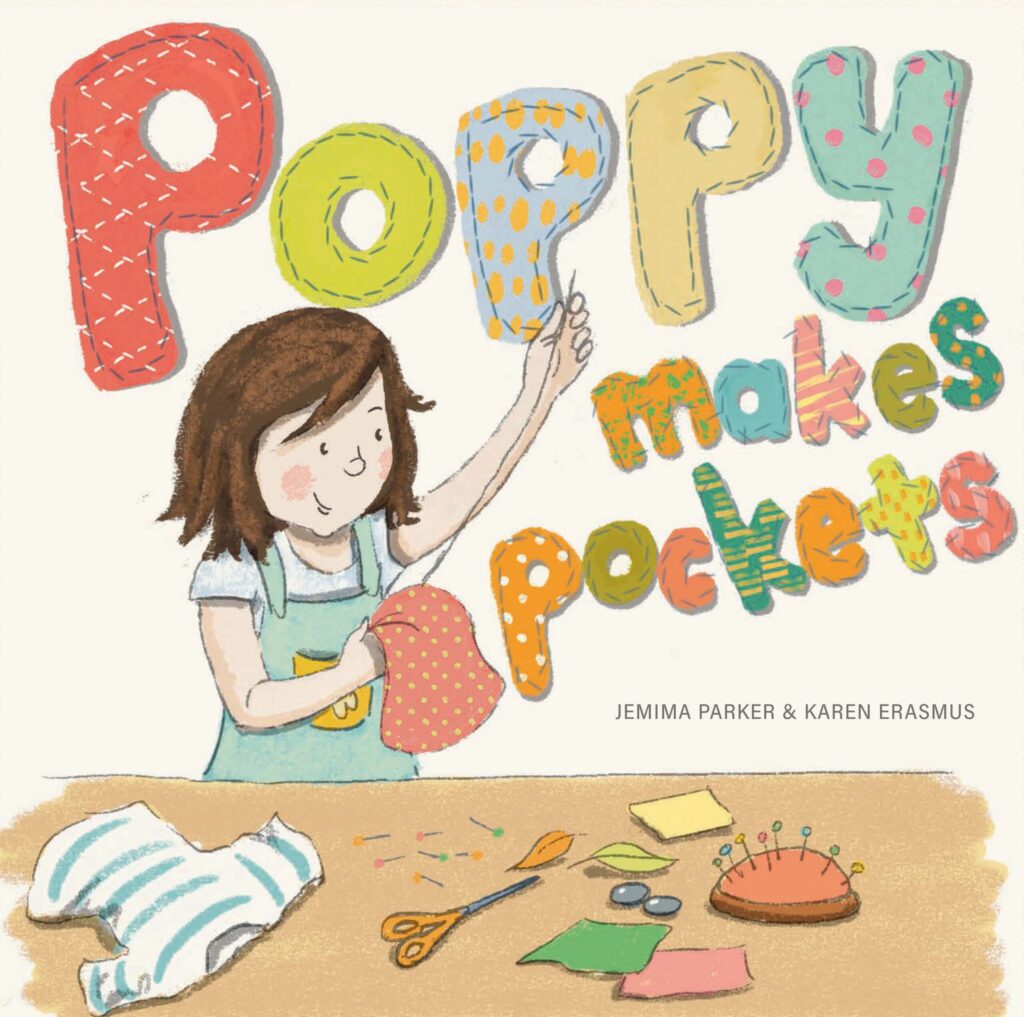
Take Poppy Makes Pockets by Jemima Parker, illustrated by Karen Erasmus, whose cover sits at the top of this post. Poppy has a simple, relatable problem: she loves collecting treasures, but her clothes have no pockets to carry them in. Over the course of the book she solves it for herself and then for her whole neighbourhood, and the story finishes somewhere that feels complete. You could easily imagine Poppy having other adventures, and that’s exactly the point. A strong character in a complete story leaves readers wanting more without the book needing to promise it.
So what do you do with your series ideas?
Don’t throw them away. Just change how you use them.
- Pick your strongest story. Look across your planned series and choose the single idea with the clearest problem and the most satisfying resolution. That’s the one to develop and submit.
- Make it complete. Rework it so it doesn’t rely on anything that happens in another book. Read it as if no other book will ever exist. Does it still work?
- Keep the others in a drawer. Your other ideas are valuable. If the first book is published and does well, you’ll be ready when your publisher asks, “What else have you got?”
- Leave the series out of your pitch. Present the book as what it is: a standalone picture book. If you want to mention other ideas, one light line is plenty, such as “I have further stories featuring this character.” There’s no need to outline them. Our step-by-step guide to pitching a children’s book publisher covers what else your cover letter should include.
A quick test for your manuscript
Read your manuscript aloud to someone who knows nothing about it, then ask them what the story was about. If their answer describes the characters and their world (“It’s about a family of hedgehogs who live under a bridge”) rather than what happened (“A hedgehog has to find her way home before winter”), your story may still be stuck in set-up mode.
Then ask yourself the question every editor asks: if this were the only book ever written about these characters, would it be enough?
A picture book series is earned by one strong book, not promised in a cover letter.
Key takeaways
- Most picture books are published and sold as standalone titles. Series usually follow a proven success.
- Pitching a series asks a publisher to commit more before they know whether the first book works.
- Don’t write your manuscript as a set-up. It needs a clear problem, an active main character and a satisfying resolution.
- Choose your strongest idea, make it complete, and keep your other stories ready for later.
- In your pitch, present the book as a standalone. One light mention of further ideas is enough.
Get ready for when EK Books submissions reopen
Knowing what publishers look for, and what quietly puts them off, is exactly what we teach at Children’s Publishing Academy, drawing on what we do every day as working publishers at EK Books. Our Children’s Author Certification takes you from first idea to a submission-ready manuscript. If you want your story to be ready for when EK Books submissions reopen, now is the perfect time to start.
Not sure whether your manuscript stands on its own? Take our free Is Your Children’s Book Ready for Publication? quiz and find out in a few minutes.